

On January 11, 2012, Digital Leisure opened a casino inside PlayStation Home, the free social space Sony ran on the PS3, where avatars collected chips from a cashier and sat down at blackjack, poker, keno, slots or a Big Six wheel. The space opened with more than 100 rewards to earn, and not one of them was money.
Casino games with the money taken out were already an old console genre by then. They ran on cartridges before the ESRB existed, on PlayStation discs through the late 1990s and on Sony’s handheld after that.
Over those decades the prize for winning shifted from a showdown with a casino boss to clothing for an avatar, and the rating boards rewrote their rules around such games more than once.
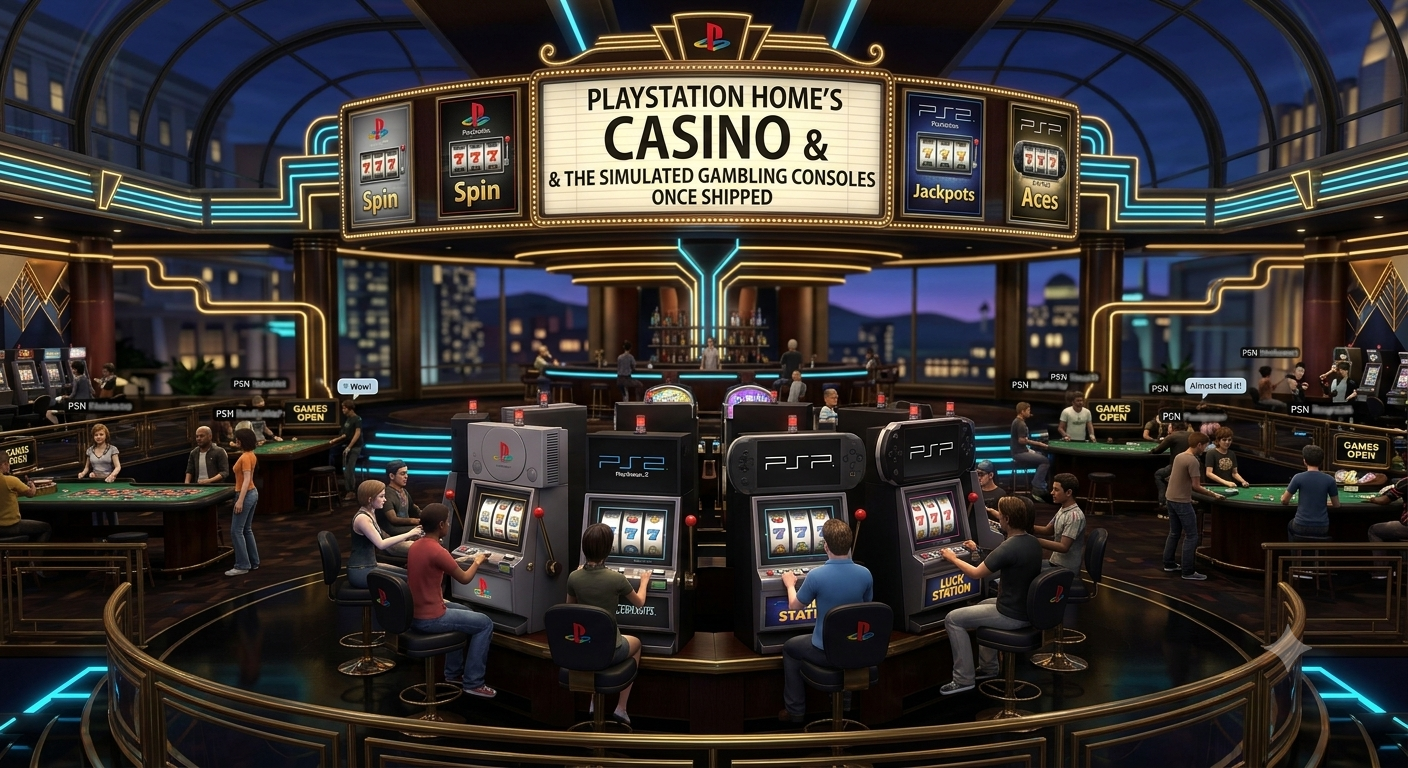
Paradise Springs Paid Out In Outfits And Furniture
Sony opened Home as a public beta in 2008. Each user got an avatar and a free starter apartment, and publishers built their own spaces around the shared plazas.
Gambling-style games reached Home before Digital Leisure did. Sony’s Home community manager wrote that players had asked for more casino-style games ever since PlayStation Home Hold ‘Em launched, and in 2011 the service added a free craps variant that turned its winners into extraterrestrials.
Digital Leisure, a publisher based in Ontario, built The Casino as one venue, the Paradise Springs Casino, where Sony’s announcement on the PlayStation Blog listed clothing, furniture and a hotel room among the rewards.
The studio kept adding tables. Video poker arrived in 2012, a free Texas Hold ’em game limited to one play a day followed a month later, and craps opened before the year ended as the casino’s first dice game. A slots variation joined the machines the year after that.
Each game carried its own rewards, and clearing the top tier in all of them earned another outfit. None of it could be cashed out, and the cashier is where that was settled. It handed over a stack without selling it, so nothing went in, and it did not buy a stack back, so nothing came out.
A winning hand paid in more chips and in progress toward the reward list, which is how one venue could deal blackjack to thousands of avatars at once and end the night owing none of them anything. When this site compared Paradise Springs with online casino sites in 2014, it led with that gap: the websites took real money, and Home’s casino never did.
Before The ESRB, A Cartridge Set The Target
Sofel released Casino Kid on the NES in 1989. The player walked in with $500, beat a string of blackjack dealers and five-card draw poker players to reach $1 million, and then faced the Casino King in a final poker match.
Vegas Stakes, which Nintendo published for the Super NES in 1993, raised the target. Freezenet’s review puts the starting bankroll at $1,000 and the winning total at $10 million, spread across blackjack, poker, craps, roulette and slots. Players who reached the total typed in what they planned to do, and the end credits told them they would do it.
Strangers interrupted the tables with side deals. A watch bought for $200 at a blackjack table drew an offer of a thousand dollars a few hands later.
Neither cartridge carried an ESRB rating. The industry set up that board in 1994, after congressional hearings on violent video games.
The format outlived the cartridge. When Nintendo put Vegas Stakes on the Wii in 2007, IGN’s Lucas M. Thomas saw the business case in his review: “After all, there’s real money to be made in offering gamers a way to gamble fake money away.”
Golden Nugget, Caesars Palace And Hard Rock On Disc
PlayStation discs swapped invented casinos for real casino names. Golden Nugget reached the console in 1997 with 16 games of chance, a $10,000 bankroll and a story mode about tracking down a stolen microchip. Caesars Palace 2000 brought a second real casino to the PlayStation three years later.
Sony’s handheld got its own version in 2007, when Hard Rock Casino arrived on the PSP with more than 15 casino games and a career mode that opened new casinos as players progressed.
Across 23 years and five platforms, the prize for winning changed shape each time.
| Game | Hardware and year | Tables and machines | What winning earned |
| Casino Kid | NES, 1989 | Blackjack and five-card draw poker | A final poker match against the Casino King |
| Vegas Stakes | Super NES, 1993 | Blackjack, poker, craps, roulette and slots | An ending the player typed in at $10 million |
| Golden Nugget | PlayStation, 1997 | 16 games of chance | Progress in a story about a stolen microchip |
| Hard Rock Casino | PSP, 2007 | More than 15 casino games | New casinos opened through career mode |
| The Casino in PlayStation Home | PS3, 2012 | Blackjack, poker, keno, slots and a Big Six wheel | Avatar clothing, furniture and a hotel room |
Where Simulated Chips Stop And Provincial Rules Start
Real-money versions of those tables now operate under provincial rules in parts of Canada. Alberta’s government says its regulated iGaming market launched on July 13, 2026. CBC News reported that sports betting and online casinos run by private companies became legal there that Monday, making Alberta the second province to open its market to private operators, after Ontario.
A licence attaches the obligations the chip loop never carried. An operator registered in the province takes a deposit instead of handing over a stack, so the balance on screen is money it owes the account holder, it settles a winning bet out of that balance in cash, and it holds a registration a provincial regulator can suspend.
The wager itself looks much the same on either side of that line. What changes is whether anyone is obliged to pay when it wins.
The province set 18 as the minimum age for online gambling, and Service Alberta Minister Dale Nally counted 22 operators cleared to take bets on launch day. LineUps’ page on the best alberta sports betting apps tracks which of them are live in Alberta and what each one takes bets on. Nally also told CBC that more were expected within three months, so the list dates quickly.
LineUps posts its sports betting video coverage, built around the NFL and MLB seasons, on its YouTube channel.
PEGI Changed Its Gambling Rule Twice In Five Years
Europe’s rating system has moved its line on casino simulations more than once. PEGI launched in 2003, and its database still lists The Casino for PS3 at PEGI 12 with a gambling descriptor. Under the criteria of that period, a game with casino-style minigames could carry a 12.
In 2020 PEGI started rating new games that simulate gambling at 18. Game Developer reported the shift in September 2021, after a blackjack scene pushed the narrative game Overboard! to 18.
The board chose not to apply the rule to older games. A PEGI spokesperson told the publication the change came “in the first part of 2020” and was left non-retroactive so a single game would not turn up “for two different consoles with two different age ratings.”
Balatro tested where the rule stopped. The poker-themed roguelike launched on PS4 and PS5 on February 20, 2024, and its PEGI rating then jumped from 3 to 18. Publisher Playstack said the change left the game temporarily removed from sale on some console storefronts in several countries.
A PEGI decision published on February 24, 2025 lowered Balatro to 12 and found that the game, although it explains poker hands, had “mitigating fantastical elements.” LocalThunk, the game’s solo developer, called it “a good step from PEGI” for criteria “that used to be 18+ or nothing.”
PEGI said it would draw finer criteria while keeping 18 for simulations of games played in casinos and betting halls, and its label guide now spells out that split: prominent gambling themes get a 12, and simulated casino games get an 18.
The ESRB separates the same two cases in North America. Its Gambling Themes descriptor covers imagery associated with real-world gambling, while Simulated Gambling is “typically assigned to simulations of casino-based gambling.”
What Survived When Home Went Dark
Sony set the end date in September 2014. The notice, covered on this site that month, stopped new Home content that autumn, gave European players until December 3 to download content and scheduled the closure for March 31, 2015.
Home had never shipped on a disc. IGN’s 2021 feature on its remaining fans noted that it could not run offline and lived entirely on Sony’s servers, so every Paradise Springs outfit, tier and hotel room disappeared with them.
The older games in the table held their progress without any network. Casino Kid handed out a password for resuming later, and Vegas Stakes saved a player’s cash whenever they went back to the hotel.
Nagato, a longtime Home player IGN interviewed in 2021, remembered the final night: “I remember at 3am they cut the server.” The next day was April 1, he said, so plenty of players assumed it was a joke. By 2021 he had spent almost two years on Destination Home, a non-profit effort to rebuild the service from cache files left on old consoles.
IGN reported in 2023 that the project had opened a closed beta the year before, putting fans online in Home together for the first time in seven years, without microtransactions. Nagato said at least 8,000 people had joined its Discord.
Code can come back without the crowd that used it. Kelsey Lewin of the Video Game History Foundation told IGN that “with online and community based games, it’s very difficult to preserve the entirety of the experience.” Sony’s blog put The Casino’s first-year audience at about a million unique visitors, and no cache file holds that crowd.