

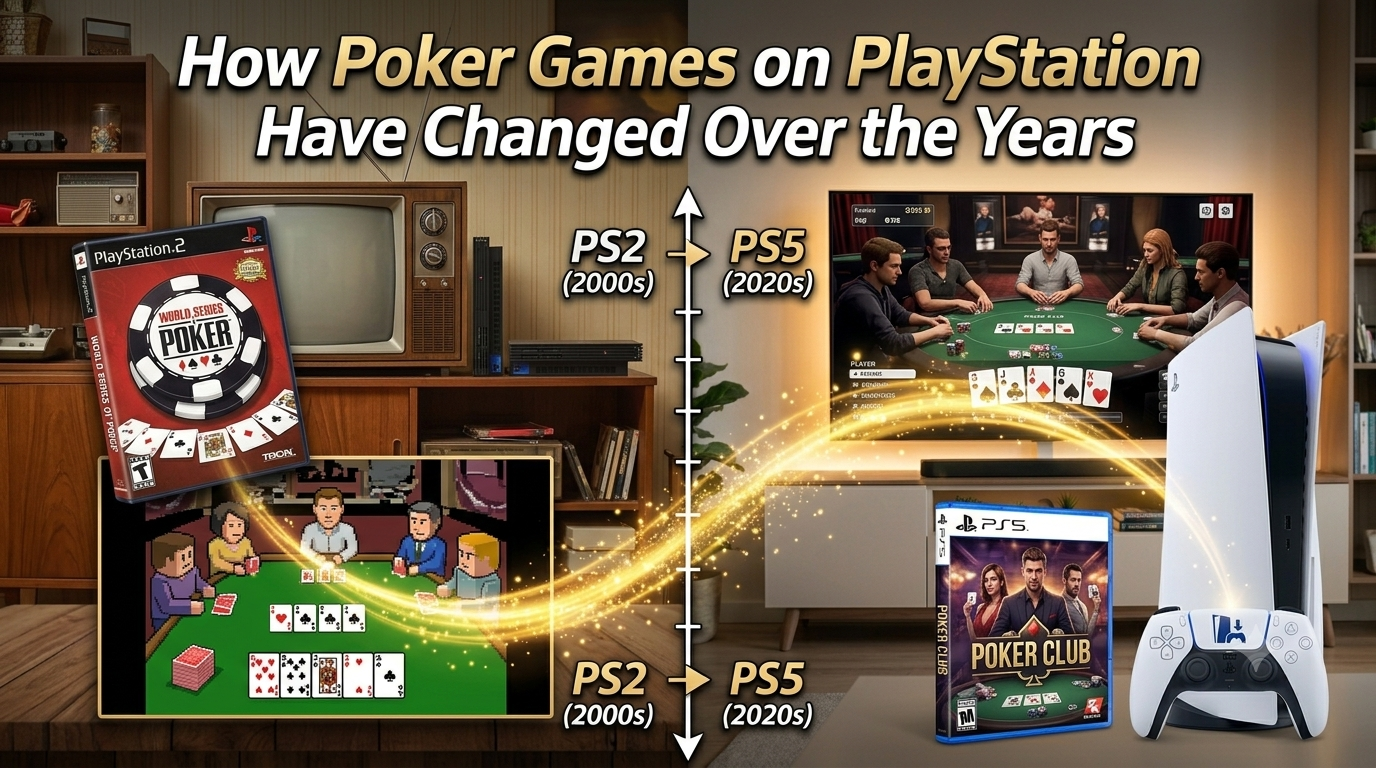
On August 31, 2005, a PlayStation 2 disc arrived with the faces of that summer’s World Series professionals rendered on it, and the pitch was that a player at home could sit across from them. Activision built the game around the 2005 tournament and shipped it on PS2 and Xbox first, with a PlayStation Portable version on September 15. That disc was not the first of its kind on the console, but it set the template every later release either copied or rejected. Twenty-one years on, almost nothing about it survives except the rules.
The PlayStation 2 Era
Coresoft and Crave Entertainment got there first. World Championship Poker reached PS2 on November 18, 2004 as the console’s first American card release of its kind, and it shipped with Texas Hold’em, Omaha Hold’em, Seven-Card Stud, Five-Card Draw and Pineapple, so a player who wanted a format the television broadcasts never showed could find it in the menu.
The wave that followed sold licenses instead. Activision put the World Series name and the likenesses of named professionals into a boxed retail product, then followed it in 2006 with a Tournament of Champions edition. A televised tournament had made specific faces famous, and a disc that let a player bust those faces was a product with an obvious buyer.
What that generation could not do was fill a table with anyone real. The opponents were scripted, their tendencies were fixed, and a player who worked out the pattern could beat the game indefinitely. Difficulty came from raising the aggression of the scripts, so the ceiling was the quality of the code rather than the quality of the opponent.
Downloadable Poker on the PlayStation 3
High Stakes on the Vegas Strip arrived on the PlayStation Store on September 13, 2007 as a download rather than a disc. That change mattered more than the game did. Distribution costs dropped to nothing, which meant a card game no longer had to justify shelf space or a retail price against a full-priced release.
The PS3 generation also had a functioning online service, so the opponents could finally be people. A player could sit in a game against strangers without a hardware add-on or a subscription to a separate service, which is the point at which console card games stopped being a solitary product.
Poker Inside Other Games
The most-played card tables on PlayStation hardware are inside games about other things. Red Dead Redemption put a no-limit Texas Hold’em table in a 1911 western in 2010, and its 2018 sequel built opponents that track player tendencies across sessions instead of resetting between hands. Far Cry 3 tied winnings to weapon upgrades in 2012, which turned every pot into a decision about equipment. Watch Dogs let a player hack the phones of the other players at the table in 2014 and read their cards outright. Rockstar’s western passed 50 million copies sold, so its saloon table has been dealt to a larger audience than every dedicated card release on the platform combined.
A minigame table is built to be finished in 15 minutes between missions, which is a different job from playing online poker, where a player sits at several tables at once and grinds one stake for an entire evening. The design brief is to make a single hand feel consequential inside a story, and Rockstar’s behavioral opponents did more for the credibility of the format than any licensed product had.
Pure Hold’em and the PlayStation 4 Reset
VooFoo Studios released Pure Hold’em on August 18, 2015, the first Texas Hold’em game on PlayStation 4. The tables were rendered in high resolution, the chip physics were the selling point of the marketing, and the price was well below that of a licensed franchise release.
Card decks and chip sets were then sold as paid add-ons. That put microtransactions in premium titles on a console card table for the first time, several years before the practice became standard across the rest of the catalog. A player paid once for the software and again for a deck design.
The absence of a tournament license is what separates it from the 2005 generation. The product was the game itself, sold on how the cards and chips behaved rather than on whose face was printed on the box, which is a harder pitch to make in a store aisle.
The Arrival of Free to Play on Console
Prominence Poker came to PS4 on August 23, 2016, developed by Pipeworks Software and published by 505 Games, and it was free. Players built a character, worked through a criminal underworld of fictional rivals, and paid only for cosmetics and chip packs.
Free-to-play solved the problem every console card game had faced since 2005. A card game needs a full table to work, and a full table needs a large concurrent population. Charging $20 at the door guarantees a small population. Removing the door charge is the only reliable way to keep 9 seats occupied at 2 in the morning, and Prominence Poker was the first PlayStation release to accept that trade.
Poker Club and the PlayStation 5 Generation
Ripstone released Poker Club on November 19, 2020, with versions on PS4, Xbox One, Xbox Series consoles and PC on the same day. Sony had confirmed the PS5 price and release date two months earlier, at $399 for the discless edition and $499 for the model with a drive, and the console reached most of the world on the same November 19. The technical claim was cross-play. A PS5 owner could sit at a table with someone on a PS4, and the PC, Xbox and Switch populations were pooled as well.
That solves the population problem from the other direction. Free-to-play fills seats by removing the price, and cross-play fills them by removing the platform. A paid card game on one console in 2015 was drawing its opponents from a fraction of one hardware base. The same game in 2020 was drawing from five.
Console Poker in Its Current Form
Console poker is now two separate things. One is a standalone free product with cosmetic monetization, a persistent player identity and matchmaking against strangers. The other is a scripted table inside a much larger game, kept short, tuned for drama, and paid for by the game around it. The licensed retail disc that started the run in 2005 is the format that did not survive, because the thing it sold was access to famous opponents, and both surviving formats give a player better opponents for free. Sony has since described the PS5 as being in the latter stage of its life cycle, which leaves Poker Club as the dedicated card release that defined this generation of hardware and leaves the next one open.