
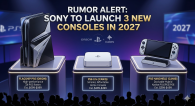
Reports from prominent hardware leakers, including Moore’s Law is Dead (MLID), suggest that Sony is planning an ambitious launch for its next generation in late 2027 or early 2028. The strategy allegedly involves three distinct devices rather than a single console.
Similar to the PS5, the PS6 will launch in two variants. One with the high-performance specs and high price tag, similar to the PS5, and another more affordable console like the PS5 Digital Edition. However, rumours also suggest that a new Handheld console will launch alongside the two home consoles.
PS6 Consoles:
- Flagship PS6 (Codename: “Orion”): A high-performance main console expected to deliver up to three times the raster performance of the PS5, but it is estimated to cost between $699 and $999.
- PS6 Lite / “PS6 S” (Codename: “Canis”): A smaller, more affordable home console designed to lower the barrier to entry, as a result it will have a lower price range of $299 to $399.
- PS6 Handheld (Codename: “Canis”): A dockable hybrid device that reportedly shares architecture with the Lite model. This console will support native playback of PS4, PS5, and early PS6 titles. Due to the portability, its expected to have a slightly more expensive price of between $399 and $499.
Technical Details & Capabilities
- Chipset Architecture: The flagship model will likely use a custom AMD Orion APU (Zen 6 cores), while the Lite and handheld models are expected to use a less powerful Canis APU (Zen 6c cores) to manage heat and battery life.
- Backwards Compatibility: All three systems are rumored to offer extensive backwards compatibility, allowing players to carry over libraries from the PS4 and PS5.
- Enhanced Features: Leaks point to a massive RAM upgrade. This could be up to 30GB or 40GB for the flagship, and include advanced AI-powered upscaling (likely an evolution of PSSR) to achieve high-fidelity visuals.
Launch Window
Sony targets a Q4 2027 launch to hit the holiday season, though global memory chip shortages and “RAMageddon” price spikes could push the release into 2028 or 2029. Sony has not officially confirmed these plans, with PlayStation architect Mark Cerny previously describing the road to PS6 as a “multi-year process”.
Rumoured Spec Comparison
| PS6 Flagship (“Orion”) | PS6 Lite / Handheld (“Canis”) |
|---|---|
| Target Performance 4K @ 120Hz / 8K @ 60Hz | Target Performance 1080p @ 60Hz (Native) / 1440p (Upscaled) |
| CPU Architecture AMD Zen 6 (Custom) | CPU Architecture AMD Zen 6c (Efficiency Cores) |
| GPU Architecture AMD RDNA 5/6 Custom | GPU Architecture AMD RDNA 5/6 (Reduced Compute Units) |
| Memory (RAM) 32GB – 40GB GDDR7 | Memory (RAM) 12GB – 16GB LPDDR5X (Shared) |
| Storage 2TB Gen5 NVMe SSD | Storage 512GB – 1TB Gen4 NVMe SSD |
| Ray Tracing Dedicated hardware ray-tracing | Ray Tracing Software/Limited hardware ray-tracing |
| Upscaling Tech PSSR 2.0 (Advanced AI) | Upscaling Tech PSSR 2.0 (Standard) |
These details are all rumours at the moment, and nothing has been confirmed by Sony. As a result, these specs may be entirely false or may change without notice.