
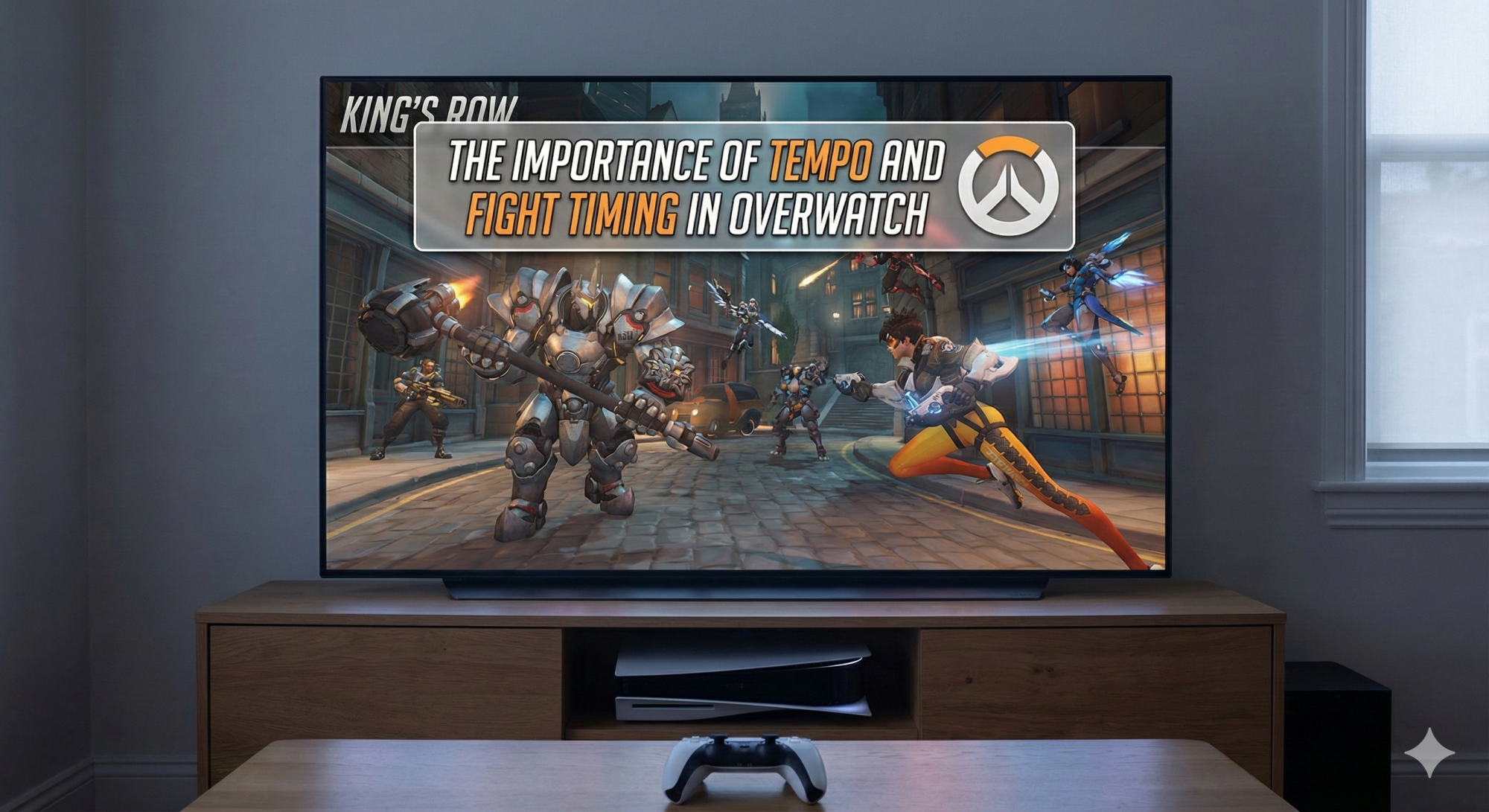
You keep losing fights you feel like you should be winning. Your aim is decent, your hero pool is solid, but somehow the enemy team keeps taking objectives while yours is scattered across the map waiting to respawn. The problem usually is not mechanics. It is timing. Knowing when to fight, when to hold back, and how to control the pace of a match is what separates players who climb from players who stall.
What “Tempo” Actually Means in Overwatch
Tempo is the speed at which the game moves and, more importantly, which team is dictating that speed. A team with a tempo advantage is making plays and forcing the enemy to react. A team without it is constantly catching up, rotating late, and fighting on the wrong terms.
Every match has a natural ebb and flow. There are moments when a fight is ripe to start and moments when pushing in would be a disaster. The best players feel that rhythm. The rest end up charging into a Graviton Surge they walked straight into.
At the highest level, this definition becomes very clear. Competitive analyst Scr1be laid this out in one of the earliest deep dives into Overwatch strategy: tempo is the speed of the game, and the team controlling that speed holds a structural advantage before a single fight is decided. It’s a concept that’s aged well because the fundamentals behind it haven’t changed.
Tempo is not just one thing. It splits into two general styles of play.
- Fast tempo: aggressive, execution-focused, built around closing distance quickly and winning fights through speed and pressure before the enemy can set up
- Slow tempo: deliberate, defensive, built around holding strong positions, draining the attacking team’s opportunities, and punishing mistakes
Neither is inherently better. A slow-tempo composition on defense can completely shut down a fast-tempo team if it plays patiently and holds the right angles. But if you’re playing a slow-tempo comp and the enemy dials up the aggression, you have to match that energy, or their poke will bleed you dry over the course of the fight.
When to Engage and When Not To
This is where most players make their biggest timing mistakes. The urge to just fight is strong. But throwing yourself into a fight before the conditions are right is one of the fastest ways to fall behind on ultimate economy, lose objective time, and slowly tilt your team.
Good engagement timing usually comes down to one of these green lights:
- You have landed a pick during poke. Even a single five versus four window is worth committing to.
- Your team has the ultimate advantage. You have two ready, and the enemy has one at best.
- The enemy is staggered. One or two players are still walking back from spawn while the rest hold the point.
If none of those conditions are met, you’re fighting on the enemy’s terms. That’s a recipe for a slow, grinding fight that their composition is probably better suited for.
Many players struggle to see these patterns in their own games. Players looking to understand how these conditions play out at higher ranks often turn to replay analysis, coaching content, or Overwatch Boosting to get placed into lobbies where they can observe better players applying these timing concepts in real matches. Watching stronger players handle these moments makes the differences in timing much easier to spot.
The Three Phases of a Teamfight
Every team fight runs through roughly the same structure. Recognizing which phase you’re in tells you exactly what you should be doing.
Poke phase: Both teams are throwing out damage, probing for weaknesses, and waiting for an opening. Flankers are getting into position. Nobody has committed yet. This is the moment where a lot of players engage too early and waste their cooldowns on nothing.
Engagement phase: One team finds an opening, such as a pick, a wasted cooldown, or a player out of position, and commits. This is where tempo gets seized or lost. If your team engages together, you snowball the advantage. If two people go in and three others are still poking at the choke, you’re throwing.
Clean-up phase: One team is winning. The job now is to close it out without overextending. Chasing enemies back to their spawn, fighting in a doorway where they are about to respawn, or burning ultimates on a half-dead team that is already running are all ways to give back the tempo you just earned.
Every fight follows a predictable pattern. This three-phase structure is why team coordination matters more than individual firepower in objective-based multiplayer games. Whether you’re running co-op or competing in ranked, timing your commitment as a unit consistently outweighs what any single player can do alone.
Ultimate Economy Is Tied Directly to Timing
Most fights are decided by which team uses their ultimates better. Overwatch is built around ultimates as the primary swing resource in any fight. They charge overtime, and how you spend them and when has a massive ripple effect on the next few fights.
The biggest mistake is holding ultimates too long. Players hoard ults, thinking they’re saving them for the perfect moment, and in doing so, they let the enemy build their own. There’s a term for this: the “ult economy trap.” You can win a fight with a numbers advantage, which builds your ult faster anyway, and then use that ult advantage to snowball into the next fight.
A few timing rules that actually matter:
| Situation | What to do |
| You have ult advantage (2 vs 1) | Engage—you’re favored |
| Both teams are even on ults | Play for a pick first before committing |
| The enemy has ults; you don’t | Stall, disengage, and avoid a full team fight |
| You just used all your ults | Reset and rebuild before fighting again |
Baiting is also underrated. Fake a rotation, make the enemy burn a defensive ultimate like Sound Barrier or Immortality Field, then back off and engage properly once those are down. That one decision can flip a fight before it even starts.
Cooldown Tracking Changes Everything
You can’t time your engagements well if you’re not tracking enemy cooldowns. The poke phase exists to create that information. You are not just dealing damage. You are watching what the enemy spends and when. Zarya’s bubbles are on a 10-second cycle each. Winston’s leap is 6 seconds. Lucio’s amp is short. You do not need to memorize every number perfectly, but you do need to notice when these abilities are used.
The moment Zarya throws a bubble at nothing during the poke phase, that’s your 10-second window. The moment you see Winston leap in and get pushed back, his leap is down. These cooldown windows are where fights get won cleanly instead of turning into grinding stalemates.
Supports and tanks have the best view of this in real time. If you’re playing Ana or Baptiste, you should be watching what the enemy tank is doing almost as closely as you’re watching your own. Call out when major cooldowns are burned. Even in solo queue, a quick call that Zarya has no bubble can change what your team does next.
The Stagger Rule Nobody Talks About
One of the most underappreciated concepts in fight timing is staggering. After winning a fight, if you’ve killed enemies at different times rather than all at once, their respawns don’t sync up. That means you’re fighting 5v4 or 5v3 before the full team reconstitutes.
The goal after winning a fight isn’t to relax and walk to the objective. It’s to kill the last surviving enemies as late as possible, deep in their territory, so their respawn timer is as long as it can be. Meanwhile, the enemy who died first is already walking back and about to fight again.
This is why cleanup matters as much as the engagement itself. Don’t chase into the spawn room because that’s how you get reversed. But do pressure the stragglers and deny the reset.
Reading the Flow Mid-Fight
Even when a fight is already happening, tempo can shift. A support going down completely changes the math. A tank using its entire kit to peel for one teammate while the rest of their team is exposed creates an opportunity to press forward.
Players who excel at this are not reacting faster. They notice that Mercy just left the fight to hide. They notice that Reinhardt is shieldless and low. They see the window opening, and they call it or move into it before the rest of their team has processed it.
Positioning shapes every engagement before it begins. Overwatch coach Spilo makes this point clearly: where you take fights depends on who in your composition benefits most from a given position on the map. Look at where people are setting up before the fight starts, not during it, and adjust around that information. That awareness is what people call game sense. It’s teachable, but it takes reps.
One of the best ways to build it faster is by reviewing your own gameplay footage. At the high frame rates modern hardware supports, timing windows that are easy to miss in real time become much more readable on replay. Watching a fight back with fresh eyes and no pressure to perform reveals patterns you’ll start recognizing live much sooner than you’d expect.
FAQ
What does “tempo” mean in Overwatch 2?
Tempo refers to which team is controlling the pace and flow of the match. A team with a tempo advantage is forcing the enemy to react to their plays rather than the other way around. It can be gained through picks, cooldown advantages, or well-timed ultimates.
When is the best time to engage in a team fight?
The best time to engage is when you have a numerical advantage (after a pick), when the enemy has wasted a major cooldown, or when you have an ult advantage. Avoid committing to a fight if none of those conditions are met.
What’s the difference between fast and slow tempo?
Fast tempo comps push aggressively, close distance quickly, and try to win through execution and speed. Slow tempo comps hold strong positions, drain the enemy’s opportunities, and win through attrition and capitalizing on mistakes.
How does ultimate economy affect fight timing?
Ultimates are a resource directly tied to when you choose to fight. Having more ultimates than the enemy is a green light to engage. Being behind on ultimates means stalling until you’ve rebuilt. Spending ults efficiently across fights creates a compounding advantage.
Key Takeaways
- Tempo is which team controls the pace of the match. The team forcing reactions has the advantage.
- Teamfights move through poke, engagement, and cleanup phases. Knowing which phase you are in shapes your decisions.
- Engage when you have a pick, a cooldown advantage, or an ultimate advantage, not before.
- Tracking enemy ultimates and major cooldowns tells you exactly when to push and when to wait
- Staggering enemy deaths after a won fight extends your objective window and delays their reset
- Ultimate economy is a fight to fight resources. Spending ultimates efficiently creates compounding advantages across the match.